29: Required reading
How and why I'm making reading a priority again.

In January, I set my Goodreads 2021 Reading Challenge goal to 30 books. I was in the middle of the first one, Girl, Woman, Other by Bernadine Evaristo, and feeling inspired, enlivened even, by the experience and the prospect of more like it. It is now June, and I have read a grand total of two books.
I took to reading fairly quickly when I was younger — an early bloomer, if you will. My mom read to me every night, and I still remember the You Read to Me, I’ll Read to You stories we paged through as I snuggled next to her. When it all clicked for me, I was in my grandma’s living room, reading some book featuring lots of animals. All of a sudden, the strings of letters resonated in a new way; they were complete words and sentences, and I understood them. It surprised me how instantaneous it was – one second struggling and piecing things together, the next fluidly gliding through the pages. People who learn second languages speak of a similar phenomenon – one morning you wake up and the words just slip out of your head and off your tongue with ease.
From then on, I read voraciously. Junie B. Jones, Nancy Drew, Magic Tree House, A Series of Unfortunate Events, and more all built up on my bookshelves over the years. Reading seemed to become an inherent part of my identity. But by middle school my tempo began to slow. I had my own computer for the first time and was beginning to discover the variety of social media platforms that had exploded in popularity. By high school, I was barely doing the assigned readings for my Lit classes, much less reading for fun when I got home from school, completely exhausted. Instead, Tumblr, YouTube, and other internet rabbit holes I fell down occupied my free time. What once seemed like an intrinsic part of me was being challenged, and it made me question how I got to that place.
I think a lot of people I know relate to this experience. Maybe their timelines or preferred genres were different, but the gradual decline of reading for pleasure in the era of digital content is certainly not an uncommon predicament. Research from the American Psychological Association and San Diego State University confirms that teenagers are reading less than ever before, with only 16% of them reading for pleasure today compared to 60% in the 1970s. According to the findings, teens are switching out print texts for online media, like social media platforms, streaming, video games, and more.
It’s not just kids, though. Adults also are reading less than they were 10 years ago, according to a Pew Research Center study from 2019. Caleb Crain hypothesizes several reasons for this in “Why We Don’t Read, Revisited” for The New Yorker. He points to a variety of reasons stemming from studies of the time usage of Americans, including work pressures and the internet, but says that it is still television that eats up the most reading time for most Americans.
The shift to digital media forms like the internet, social media, and television makes sense. I feel like I’ve become accustomed to constant dopamine hits from the micro-bites of content from Tik Tok and the endless options offered on streaming services like Netflix. If reading is a complex multi-course dinner, digital content is a fast-food meal – not to say that the latter things are inherently bad, but rather that both things are quick, cheap, and instantly gratifying. At this point, even sitting down for a two-hour movie can feel like a daunting commitment.
But I think there’s a little more nuance to this. These choices don’t always occur in a vacuum, and though I think burn out is an overplayed concept, it may be relevant here. Whether academic stressors (which often include a lot of assigned reading!) or lack of work/life balance is the root cause of a person’s burn out, it makes sense why someone would opt for the path of least resistance to unwind and relax. Reading, of course, can be very fun and exciting, but picking up a phone and mindlessly scrolling is easier for most people, especially since it’s more habitual.
A couple years ago, Haley sent me a video on YouTube entitled “Bookstores: How to Read More Books in the Golden Age of Content,” and the creator Max Joseph echoes a lot of what I’ve said so far: the avid reader to picks-up-a-book-once-a-year pipeline, the competition for our attention (I really want to read How to Do Nothing by Jenny Odell, one of hundreds on my to-read list!), and why reading is so important. In the introduction, he references a habit I’m extremely guilty of: being lured into buying books despite having dozens of unread ones at home — I think Haley would have some thoughts on this re: mindful shopping and retail therapy. Watching the video motivated me, but it also overwhelmed me thinking about how many books I wanted to read and how few of them, in the grand scheme of things, I would actually be able to, and how much time I had wasted already. I was, and still am, almost a bit embarrassed about how un-well-read I am, despite having an English degree.
Ultimately, though, that feeling is unproductive and doesn’t help me read those books that are collecting dust on my nightstand. What I have gleaned from that video, from friends, and from Tik Tok (it is useful on occasion!) is that the key to actually reading every day in a sustainable way is making it fun and accessible. Here are some tips I have gathered:
When getting back into reading, don’t stick to one genre or even one book. It’s ok to switch around if you aren’t clicking with a text — find something that excites you and makes you want to keep picking it up.
Revisit genres or books from when you were a kind. This ties into the point above — don’t feel obligated to read certain things just because they’re popular or classic. Spoiler alert: you won’t finish them. If you previously have enjoyed historical romances or dystopian sci-fi novels, go back to those! Once you establish a more regular reading routine, it will be easier to branch out and try new genres and subjects.
Carve out time in your day to read, even if it’s only 5 to 10 minutes. This seems obvious, but I sometimes delude myself into thinking I will magically be compelled to read all the time and seamlessly weave it into my day. I think forming an intentional habit, like reading a few pages before you go to sleep, is essential.
Limit distractions if possible. I have apps on my laptop and computer that limit my time on certain apps to prevent myself from aimlessly consuming content that takes time away from hobbies I am genuinely passionate about.
Don’t put pressure on yourself to read a certain number of pages or finish books on a certain timeline. Maybe my Goodreads challenge is a mistake! I think any sort of pressure or expectation makes reading begin to seem like a chore rather than a source of enjoyment. It doesn’t matter how quickly you read or how many books you can finish in a certain time, what matters is that you’re reading in the first place.
Put books in places that are easily accessible! Have a couple to choose from in your backpack or purse at all times to read on the bus, train, or any other idle time during the day. Display books — again, ones that excite you! — in high-visibility places in your space so that you are more likely to pick them up.
Make it into a social event, if that will make it more appealing to you. I am in two book clubs, one with friends and one with my sister, mom, and grandma, and having that accountability as well as people to discuss with makes me much more likely to finish the book. It’s so nice to be able to connect with people in that way, especially since reading is generally a solitary activity.
The good news is that books and reading are not dead — according to NPD Bookscan, sales for print books during the pandemic were the best they had been in years. Furthermore, Global English Editing found that around the world 35% of people reported reading more during the pandemic than they had previously.
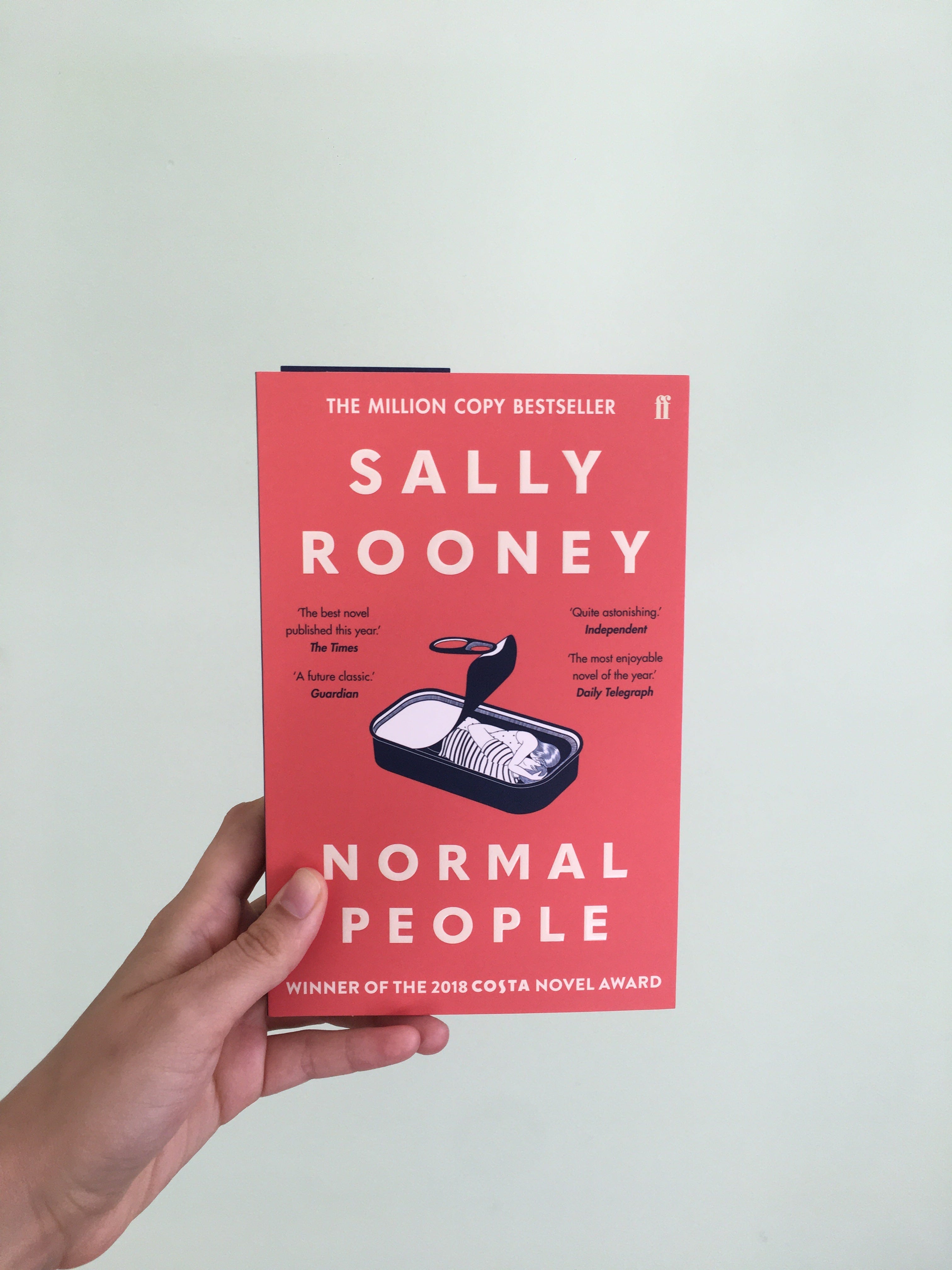
While I can’t necessarily say I read more than average during the pandemic, I did my best. I read Normal People just before my exam period, an effort to delay writing my essays. I devoured it in a couple days, proving to myself my love was not dead, just dormant. When I finished it, it was a beautiful May afternoon in England. Somewhat uncomfortably, I read on a towel in the grass. All of a sudden, the last few pages hit me like a truck and the world melted around me. The words unsettled something in my chest that had been stuck there for God knows how long. I laid on my back and cried, tears falling silently down my cheeks into my hair. Yes, I thought, this is what it was like to read a good book.
The experience opened my eyes to another reason why I had been avoiding reading. During such a turbulent time, many people turned to vices that numbed them from the hard reality they were confronted with. In my case, this was digital and social media. Whether consciously or subconsciously, I avoided things that forced me to feel too much, to engage with a sentimentality that felt precarious to the point of danger. Yes, doom scrolling was depressing, but in a way that was so incalculable that it was deadening.
Allowing myself the melancholic pleasure of reading that book reminded me of the importance of the activity in the first place. Reading connects me more to myself, to other people, to the world. I don’t think reading in and of itself makes me a good person, but it makes me want to be more understanding and thoughtful. To think outside of myself more. It is a gift, I think, the words and their authors give us when they move us so deeply. In her essay “Letter to Borges,” Susan Sontag captures everything I want to say:
“Books are not only the arbitrary sum of our dreams, and our memory. They also give us the model of self-transcendence. Some people think of reading only as a kind of escape: an escape from the “real” everyday world to an imaginary world, the world of books. Books are much more. They are a way of being fully human.”
I might not make it to 30 books this year. I might not even make it to 13, or three. But I really, truly want to revisit that part of my young self, the one that could read that many books in a week. I do not want to continue desensitizing myself to life. I want to read. I want to be more fully human.
Some music recs! I gave Wolf Alice’s new album Blue Weekend a quick listen-through and kept coming back to the song “No Hard Feelings,” a melancholic break-up tune about being on good terms after a tough split. It is sweet and light but with big emotion bubbling beneath the surface. On the other end of break-up song spectrum (to be clear, I am not going through a break-up!) is “good 4 u” by Olivia Rodrigo, a favorite of the Tik Tok girlies. Catch me driving to work and the grocery store screaming “LIKE A DAMN SOCIOPATH” on any given day. Finally, I have been loving “Todo De Ti” by Rauw Alejandro, a bright and poppy single that’s a departure from his usual reggaeton sound. Very, very fun for the summer.
Both Haley and I made pasta salad earlier this week, unbeknownst to us at the time. I’m not going to write out a full recipe, but the salad ingredients were as follows: orecchiette, cooked and chopped asparagus, quartered cherry tomatoes, diced red onion, finely chopped Kalamata olives, chickpeas (optional), and feta or parmesan on top (vegan, if you are like me). The dressing consisted of balsamic vinegar, lemon, garlic, olive oil, and a tiny bit of honey. It has been hot as hell in Minnesota for the past week, so cool and light dinners are welcome.
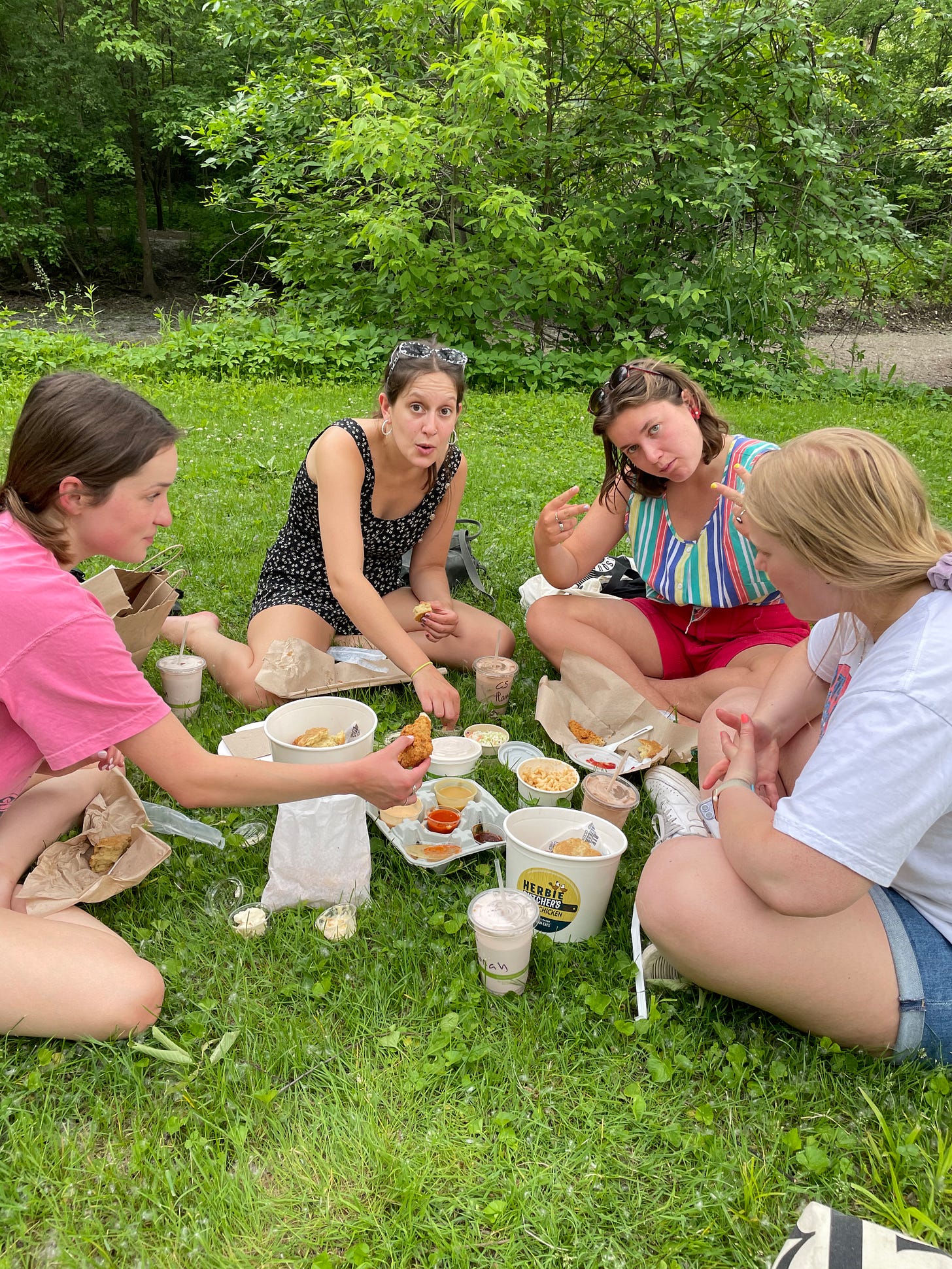
I saw my friend Hannah for the first time in a year and a half (!!!) and along with some other good friends in Minneapolis, we got take-out from the newly opened Herbie Butcher’s Fried Chicken and ate our veritable feast on a grassy area near Minnehaha Creek. It was one of the first times I have hung out with a big group of old friends in a long time, and it made me miss college where that was a near daily occurrence, but also hopeful for more times like it on the horizon. Anyway, if you are vegan and like fried chicken, mac and cheese, coleslaw, and biscuits (or their vegan approximations), check out Herbie Butcher.
My sister and I committed to watching all of Anthony Bourdain’s No Reservations and Parts Unknown in chronological order. While I have long been a fan of the shows, I watched them all out of order and as a result feel like there are likely many good episodes I’m missing out on. Yesterday was the third anniversary of his death and thinking about it jars me just as much as it did when I learned about it while sitting and eating my lunch in St Stephen’s Green. The grief I feel for someone I didn’t know is still confusing, and often feels nonsensical or even selfish – it’s something I think I want to unpack more in a future newsletter. Regardless, I have been missing him and his voice, and re-watching his shows brings a sense of comfort.